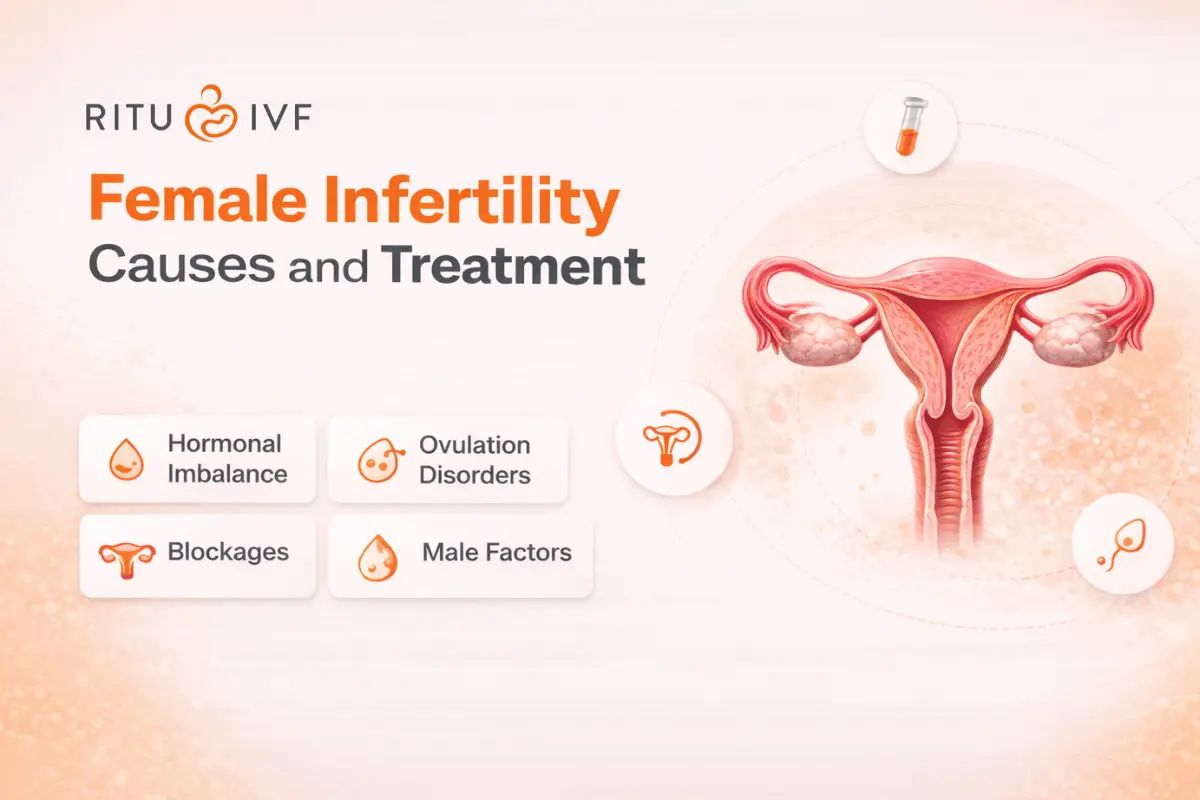
Understanding female infertility causes and treatment is the first step every couple struggling to conceive must take. Female infertility causes and treatment options vary widely yet 1 in 6 couples globally face this painful reality, according to the World Health Organization (WHO). So why women can’t get pregnant, even after months of trying? The answer often lies in three key medical conditions that quietly affect the reproductive system. In this guide, we break down each cause clearly and explain the most effective treatments available today.

Ready to take the next step toward parenthoo
[Book an Appointment Now]
Quick Overview: Female Infertility at a Glance
Cause | Key Symptom | Treatment |
PCOS | Irregular or absent periods | Medications, Lifestyle, IVF |
Blocked Fallopian Tubes | No symptoms / pelvic pain | Laparoscopy, IVF |
Hormonal Imbalance | Irregular cycles, weight gain | Hormone therapy, IUI, IVF |
Cause 1: PCOS and Infertility in Women
Polycystic Ovary Syndrome (PCOS) is the leading cause of female infertility, affecting 8-13% of women of reproductive age worldwide (WHO). PCOS and infertility in women are closely linked because the condition directly disrupts ovulation, the process of releasing a mature egg each month. Without regular ovulation, pregnancy becomes very difficult to achieve naturally.
In women with PCOS, the ovaries produce excess male hormones (androgens), which interfere with egg development. This leads to small, undeveloped follicles forming on the ovaries instead of a mature egg being released. PCOS is one of the most common reasons why women struggle to get pregnant yet it is also one of the most treatable.
How PCOS Affects Fertility
- Prevents regular ovulation, no egg, no pregnancy
- Causes hormonal imbalance, high androgen levels
- Leads to irregular or missed menstrual cycles
- Increases risk of miscarriage even if conception occurs
- Often associated with insulin resistance and weight gain
Treatment for PCOS-related infertility includes ovulation-inducing medications like Letrozole or Clomiphene, lifestyle changes, and IVF treatment for female infertility in cases that do not respond to simpler treatments.
Cause 2: Blocked Fallopian Tubes, A Silent Barrier
The fallopian tubes are the pathways that carry the egg from the ovary to the uterus. When these tubes are blocked or damaged, sperm and egg cannot meet, making natural conception impossible. Blocked fallopian tubes treatment is one of the most important areas of female infertility care, as this condition often shows no noticeable symptoms until a woman tries to conceive.
The most common causes of blocked tubes include pelvic inflammatory disease (PID), endometriosis, previous abdominal surgeries, or sexually transmitted infections. A simple diagnostic test called hysterosalpingography (HSG) can confirm whether the tubes are open or blocked. Early diagnosis is key to choosing the right path forward.
Key Facts About Blocked Fallopian Tubes
- Often called a silent condition, no obvious symptoms
- Responsible for up to 25-30% of female infertility cases
- Pelvic infections and endometriosis are leading causes
- Diagnosed through HSG test or laparoscopy
- Hydrosalpinx (fluid-filled tubes) reduces IVF success if untreated
Blocked fallopian tubes treatment options include laparoscopic surgery to open or remove the blocked tube. When surgery is not suitable, IVF treatment for female infertility offers the most effective path, since it bypasses the tubes entirely.
Cause 3: Hormonal Imbalance and Ovulation Disorder
Hormones are the control system of the female reproductive cycle. Even a small imbalance in hormones like FSH (Follicle Stimulating Hormone), LH (Luteinizing Hormone), prolactin, or thyroid hormones can disrupt ovulation completely. This is one of the most overlooked causes of female infertility and one of the most responsive to treatment.
Conditions like hypothyroidism, hyperprolactinemia, and premature ovarian insufficiency (POI) prevent the brain from sending the right hormonal signals to the ovaries. Without these signals, the ovaries cannot release a healthy egg, and why women can’t get pregnant despite having a normal uterus and open tubes.
Common Hormonal Causes of Infertility
- Thyroid disorders, hypothyroidism disrupts menstrual cycles
- High prolactin levels, suppress ovulation naturally
- Low AMH levels, indicate poor ovarian reserve
- FSH/LH imbalance, prevents follicle development
- Premature ovarian insufficiency, early egg supply depletion
Treatment depends on the underlying hormonal cause. Thyroid issues are treated with medication; high prolactin responds to bromocriptine; and ovulation can often be restored through hormonal therapy or ovulation induction. When these approaches fail, assisted reproduction remains a strong option.
Female Infertility Causes and Treatment Options
Once the cause is identified, female infertility causes and treatment planning becomes much more precise and effective. Modern fertility medicine offers a range of solutions, from simple oral medications to advanced assisted reproductive technologies. The right treatment depends on the woman’s age, specific diagnosis, and how long she has been trying to conceive.
Understanding female infertility causes and treatment also means understanding that most women do achieve pregnancy with the right medical support. Below is a comparison of the most commonly used treatment options.
| Treatment | Best For | Success Rate |
| Oral Medications (Letrozole/Clomiphene) | PCOS, ovulation disorders | 20-40% per cycle |
| IUI (Intrauterine Insemination) | Mild male factor, unexplained infertility | 10-20% per cycle |
| Laparoscopic Surgery | Blocked tubes, endometriosis, fibroids | Restores natural conception |
| IVF (In Vitro Fertilization) | Severe infertility, failed other treatments | Up to 48.5% under age 35 |
IVF treatment for female infertility remains the gold standard for women with blocked tubes, severe PCOS, poor ovarian reserve, or unexplained infertility. IVF success rates are highest in women under 35, reaching up to 48.5% per cycle. Your fertility specialist will recommend the most appropriate treatment after a thorough diagnostic evaluation.
When Should You See a Fertility Doctor?
According to WHO, infertility is defined as failure to achieve pregnancy after 12 months of regular unprotected intercourse. However, some women should seek help sooner. Do not wait, early evaluation leads to better outcomes.
- Under 35 years: See a doctor after 12 months of trying
- Over 35 years: See a doctor after 6 months of trying
- Irregular or absent periods, do not wait, see a doctor now
- History of PCOS, endometriosis, or pelvic infections
- Two or more miscarriages in a row
- Previous abdominal or pelvic surgery
Ready to take the next step toward parenthoo
[Book an Appointment Now]
Frequently Asked Questions (FAQs)
Q1: What are the main female infertility causes and treatment options?
The three main causes are PCOS, blocked fallopian tubes, and hormonal imbalance. Each of these disrupts ovulation or egg transport. Female infertility causes and treatment depend on accurate diagnosis. Options range from medications and IUI to laparoscopy and IVF, depending on the underlying cause and the woman’s age.
Q2: Can PCOS be treated to help a woman get pregnant?
Yes, PCOS and infertility in women is one of the most treatable combinations in fertility medicine. Most women with PCOS respond well to ovulation-inducing medications like Letrozole. Lifestyle changes, weight management, and IVF are also effective options for women who do not ovulate with medication alone.
Q3: Is blocked fallopian tubes treatment possible without surgery?
In most cases, physically blocked or damaged tubes require laparoscopic surgery to correct. However, IVF treatment for female infertility is a highly effective non-surgical alternative. It completely bypasses the fallopian tubes, allowing fertilisation to happen in a laboratory setting. Your doctor will recommend the best approach based on the severity of the blockage.
Q4: How successful is IVF treatment for female infertility?
IVF treatment for female infertility has a live birth rate of up to 48.5% per cycle for women under 35. Success rates decrease with age, women aged 38-40 have approximately 26-27% per cycle. Factors like egg quality, embryo health, and the experience of the fertility team all significantly influence outcomes.
Q5: Why can’t some women get pregnant even after treatment?
Why women can’t get pregnant even after treatment can involve several complex factors. These include poor egg quality, unexplained implantation failure, age-related decline in ovarian reserve, or undetected genetic issues in the embryo. Multiple treatment cycles, preimplantation genetic testing (PGT), or donor eggs may improve outcomes in such cases.