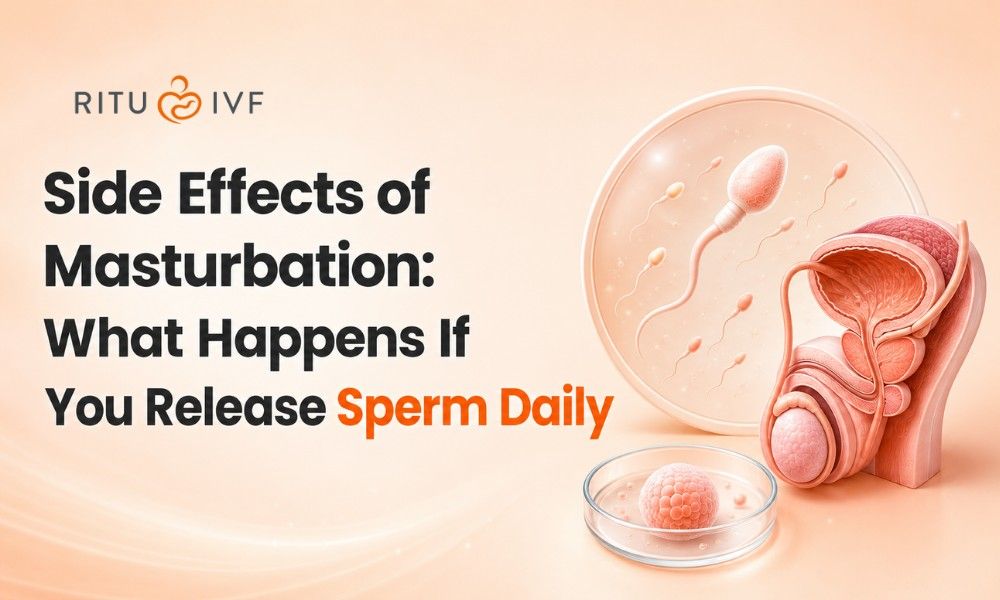
The side effects of masturbation are among the most searched medical topics globally, yet they remain one of the least openly discussed in clinical or social settings.
Millions of young men type these exact questions into search engines every single day. What are the side effects of masturbation? What happens if we release sperm daily? Is this harming my health? Am I normal? The problem is that most of the answers they find are either medically inaccurate, excessively alarming, or driven by cultural myths rather than clinical evidence.
Misinformation about this topic causes enormous, unnecessary anxiety in young men across India and the world. Myths passed down through social circles, messaging apps, and unverified internet sources create fear around a normal human physiological function.
This guide exists to replace that fear with facts.
Dr. Ritu Agarwal, Senior Fertility Specialist and Founder of Ritu IVF Jaipur, regularly addresses male reproductive health concerns including questions about masturbation frequency, sperm health, and fertility impact. According to Dr. Ritu Agarwal, the most important service a medical content platform can provide on this topic is accurate, non-judgmental, evidence-based information that helps men make informed decisions about their own health.
Every claim in this guide is supported by current medical research. No moral judgments. No cultural shaming. Just science.

Ready to take the next step toward parenthood
[Book an Appointment Now]
What Does Science Actually Say About Daily Masturbation?
Before addressing the side effects of masturbation, it is essential to establish what the medical consensus actually says.
The World Health Organization (WHO) and the American Urological Association both recognize masturbation as a normal part of human sexual behavior across all age groups. Neither organization classifies masturbation as medically harmful when practiced in moderation.
The clinical definition of “moderate” versus “excessive” is not based on a specific daily or weekly number. It is based on whether the behavior causes distress, interferes with daily functioning, or produces measurable physical or psychological harm.
Quick Facts: What Research Actually Shows
| Claim | What Research Shows |
|---|---|
| Moderate masturbation causes permanent weakness | Not supported by any peer-reviewed study |
| Daily ejaculation permanently reduces sperm count | False: sperm count recovers within 24 to 48 hours |
| Masturbation lowers testosterone permanently | No evidence of permanent testosterone reduction |
| Masturbation causes infertility | No evidence for moderate frequency |
| Masturbation improves prostate health | Some evidence supports reduced prostate cancer risk with regular ejaculation |
| Masturbation relieves stress | Supported by oxytocin and endorphin release research |
The science is clear. Moderate masturbation is not medically harmful. The concerns arise specifically with compulsive, excessive behavior that begins to interfere with physical health, relationships, or mental wellbeing.
What Happens If We Release Sperm Daily: Physical Effects Explained
This is the most searched question on this topic, and it deserves a thorough, scientifically grounded answer.
What happens if we release sperm daily from a physiological standpoint begins with understanding how the male body produces sperm. The human body produces approximately 1,500 sperm cells every single second. That amounts to roughly 130 million sperm per day in a healthy male.
The full spermatogenesis cycle, the process by which new sperm are produced from start to finish, takes approximately 74 days. However, the mature sperm stored in the epididymis are replenished much more rapidly, typically within 24 to 72 hours of ejaculation in healthy men.
Short-Term Physical Effects of Daily Ejaculation:
- Temporary reduction in sperm concentration per ejaculation
- Slightly lower semen volume in consecutive same-day ejaculations
- Mild physical fatigue if frequency is very high
- Possible temporary reduction in sperm motility with very frequent ejaculation
- Minor scrotal aching in some men due to epididymal pressure relief
Long-Term Physical Effects of Daily Ejaculation:
Research consistently shows that there are no permanent physical harms from daily ejaculation in otherwise healthy men. Sperm concentration, motility, and morphology all return to baseline parameters within 24 to 48 hours for most men under the age of 40.
Daily Ejaculation vs Abstinence: Effects on Sperm Parameters
| Factor | Daily Ejaculation | 2 to 5 Days Abstinence |
|---|---|---|
| Sperm Volume per Ejaculate | Slightly Reduced | Optimal |
| Sperm Concentration | Temporarily Reduced | Optimal |
| Sperm Motility | Largely Unchanged | Slightly Better |
| Sperm Morphology | Unchanged | Unchanged |
| Recovery Time to Baseline | 24 to 48 Hours | Not Applicable |
The key takeaway is that what happens if we release sperm daily is largely temporary and self-correcting in healthy individuals. The body adapts and replenishes efficiently.
Side Effects of Masturbation on Hormones and Testosterone
One of the most persistent fears among young men is that masturbation and testosterone levels are negatively linked. The concern is that frequent masturbation depletes testosterone over time.
Here is what the research actually shows.
A 2021 study examining testosterone levels before and after ejaculation found that testosterone shows short-term fluctuations following ejaculation but returns to baseline within hours. Critically, the same research confirmed that daily masturbation does not produce a cumulative, permanent decline in testosterone levels.
A separate study found that testosterone levels peak measurably after 7 days of complete abstinence. This has been misinterpreted by some communities as evidence that abstinence permanently raises testosterone. It does not. It simply reflects a short-term accumulation effect. Once ejaculation occurs, levels return to the individual’s normal baseline.
Hormones Released During Ejaculation:
- Dopamine: Creates the reward sensation associated with ejaculation
- Oxytocin: Produces feelings of bonding and relaxation
- Prolactin: Creates the post-ejaculatory refractory period and sense of satisfaction
- Endorphins: Natural pain-relieving and mood-elevating chemicals
- DHEA (Dehydroepiandrosterone): Released in small amounts, supports immune function
The side effects of masturbation on hormones only become clinically relevant when behavior becomes compulsive. Compulsive masturbation can dysregulate the dopamine system over time, potentially reducing sensitivity to normal reward stimuli. This is a neurological concern, not a testosterone concern.
Ready to take the next step toward parenthood
[Book an Appointment Now]
What Are the Disadvantages of Releasing Sperm Daily by Hand?
Let us address this question with clinical precision. What are the disadvantages of releasing sperm daily by hand specifically, as opposed to ejaculation during intercourse?
The mechanism of ejaculation is physiologically identical regardless of the method. The body does not distinguish between ejaculation through masturbation or intercourse in terms of hormonal response or sperm depletion. The specific disadvantages relate to behavior patterns and frequency, not to the act of masturbation itself.
Physical Disadvantages When Frequency Is Excessive:
- Skin irritation, chafing, or minor abrasions from repetitive friction without adequate lubrication
- Temporary penile desensitization with very high frequency, leading to delayed ejaculation during partnered intercourse
- Physical fatigue and reduced energy levels if the behavior disrupts sleep patterns
- Lower semen volume available for same-day intercourse
- Temporary scrotal discomfort from frequent epididymal emptying
Psychological Disadvantages in Certain Contexts:
- Guilt and shame in individuals from culturally conservative backgrounds, leading to anxiety cycles
- Performance anxiety in partnered sexual situations if masturbation has created unrealistic desensitization
- Compulsive behavior patterns where masturbation is used as an avoidance mechanism for stress, loneliness, or emotional discomfort
- Reduced motivation for real-life intimacy if masturbation becomes the primary sexual outlet
- Anxiety and obsessive thought patterns around frequency for men who are already anxious about health
Relationship and Social Disadvantages:
- Reduced interest in partnered intimacy when masturbation frequency is very high
- Partner dissatisfaction if one partner prefers intimacy and the other consistently redirects to solo behavior
- Social withdrawal in cases where compulsive behavior occupies significant daily time
The disadvantages of releasing sperm daily by hand are therefore primarily relevant at excessive frequency levels or in specific psychological and relationship contexts. At moderate frequencies, these disadvantages are either absent or negligible.
Side Effects of Masturbating on Brain and Mental Health
The side effects of masturbating on the brain represent one of the most important and least understood dimensions of this topic in 2025 and 2026.
The brain’s dopamine reward system is involved every time ejaculation occurs. Dopamine creates the pleasure sensation associated with sexual behavior. This is entirely normal and healthy at moderate frequencies.
The problem emerges with compulsive, very high-frequency behavior combined with pornography consumption. A growing body of 2024 research has documented a condition researchers call Porn-Induced Erectile Dysfunction (PIED), where men develop erectile difficulties with real-life partners because their dopamine system has been conditioned to respond only to highly novel, stimulating visual content.
Masturbation Effects on Brain: Key Research Findings:
- Moderate masturbation activates the same reward pathways as other pleasurable activities and does not damage the brain
- Compulsive masturbation combined with heavy pornography use can reduce dopamine receptor sensitivity over time
- Men with compulsive sexual behavior show patterns similar to other behavioral addictions on neuroimaging studies
- Positive masturbation effects on health on the brain include reduced stress, improved sleep quality, and temporary mood elevation through endorphin and oxytocin release
- Anxiety and depression are associated with compulsive masturbation, though research indicates these are more often pre-existing conditions rather than caused by masturbation itself
When to Be Concerned About Mental Health Impact:
- You feel unable to control the frequency despite wanting to stop
- The behavior is your primary coping mechanism for negative emotions
- You feel significant shame, anxiety, or depression related to the behavior
- Real-life sexual functioning has changed
Daily Masturbation and Sperm Count: What Research Says
Daily masturbation sperm count is a clinically important topic, particularly for men who are planning to start a family.
Understanding the relationship between ejaculation frequency and sperm parameters requires understanding spermatogenesis. The full production cycle of new sperm takes approximately 74 days from stem cell to mature, motile sperm. However, the mature sperm stored and waiting for ejaculation in the epididymis are replenished within hours to days.
Research on sperm health and masturbation consistently shows that daily ejaculation temporarily reduces sperm concentration per ejaculate but does not permanently reduce the total sperm-producing capacity of the testes.
Abstinence Period and Sperm Parameter Quality
| Abstinence Period | Sperm Volume | Sperm Concentration | Sperm Motility | Clinical Relevance |
|---|---|---|---|---|
| Less than 24 hours | Reduced | Reduced | Normal | Not ideal for testing or IUI/IVF |
| 1 to 2 days | Normal | Normal | Best | Good for conception attempts |
| 2 to 5 days | Optimal | Optimal | Optimal | Recommended for IUI, IVF, semen analysis |
| More than 7 days | Increased Volume | Higher but older sperm | Reduced | Higher DNA fragmentation risk |
This table explains why fertility specialists including Dr. Ritu Agarwal at Ritu IVF Jaipur routinely advise a specific abstinence window of 2 to 5 days before semen analysis and before IUI or IVF egg retrieval procedures. It is not because masturbation is harmful. It is because this window produces the optimal sperm parameters for clinical fertility procedures.
Daily masturbation sperm count concerns are therefore relevant primarily in two specific contexts: the days immediately before a fertility procedure, and in men who are already borderline on sperm count parameters where temporary daily reduction pushes them below clinical thresholds.
Masturbation and Fertility: Does It Affect Your Chances of Conception?
The direct answer to this question is that masturbation and fertility are not negatively linked at moderate frequencies.
Moderate masturbation does not cause infertility. It does not damage the sperm-producing cells of the testes. It does not permanently reduce sperm count, motility, or morphology. The global medical consensus on this point is clear and consistent.
However, there are specific contexts where ejaculation frequency does matter for fertility:
When Ejaculation Frequency Matters for Fertility:
- Ejaculating on the same day or the day before planned intercourse for conception reduces sperm concentration available for fertilization
- Very frequent ejaculation in the week before a semen analysis can produce temporarily low results that may lead to unnecessary concern or misdiagnosis
- Men with already borderline low sperm counts should follow their fertility specialist’s recommendations about abstinence windows
- Before IUI or IVF egg retrieval, the clinic-prescribed abstinence period must be followed precisely for optimal results
When It Does Not Matter:
- General daily health and wellbeing in men not actively trying to conceive
- Long-term sperm production capacity in healthy men under 40
- Fertility potential assessed over a longer time horizon rather than a single ejaculate
For personalized guidance on how ejaculation frequency may affect your specific fertility situation, visit the IVF Clinic in Jaipur at Ritu IVF for a comprehensive male fertility evaluation.
Myths vs Facts: Separating Science From Social Media
Some of the most harmful misinformation about excessive masturbation side effects comes not from medical sources but from social media communities, messaging groups, and unverified wellness content.
| Myth | Medical Fact |
|---|---|
| Masturbation causes blindness | No scientific basis whatsoever |
| Daily masturbation causes permanent physical weakness | Not supported by any peer-reviewed research |
| Masturbation shrinks or damages the penis | Medically impossible |
| Masturbation causes hair loss or baldness | No direct causal link established |
| Masturbation always leads to infertility | Completely false for moderate frequency |
| NoFap will cure erectile dysfunction, depression, and social anxiety | Clinical evidence is weak; some men benefit from reduced pornography use, but abstinence alone is not a medical treatment |
| Masturbation causes acne | Weak or no evidence of a direct causal relationship |
| Releasing sperm weakens the body and mind | Not supported by biochemical or physiological research |
| More frequent masturbation means lower testosterone forever | Temporary fluctuations only; no permanent decline |
| Does masturbation cause weakness in muscles or athletic performance | No clinical evidence supports this claim |
The does masturbation cause weakness myth is particularly persistent in Indian cultural contexts. The belief that semen contains vital life force that must be conserved has deep cultural roots but no biochemical foundation. Semen is primarily composed of water, proteins, fructose, and trace minerals. Its loss does not deplete the body of any irreplaceable resource.
How Often Is Masturbation Normal? A Doctor’s Perspective
There is no universal medically defined “normal” frequency for masturbation. This is not a vague answer. It is the accurate one.
Research surveys on masturbation frequency show enormous variation across age groups, relationship statuses, and cultural backgrounds. Some men masturbate several times daily. Others do so once a week or less. Both can be completely normal depending on the individual.
Is daily masturbation harmful from a purely frequency-based perspective? For the majority of healthy men, the answer is no.
The only medically meaningful definition of “too much” is behavioral: masturbation becomes a clinical concern when it causes personal distress, interferes with work or daily functioning, damages intimate relationships, or produces physical symptoms such as pain, skin damage, or erectile changes.
Approximate Frequency Ranges by Age Group From Research Surveys:
- Ages 18 to 29: Most commonly reported 2 to 7 times per week
- Ages 30 to 39: Most commonly reported 1 to 5 times per week
- Ages 40 to 49: Most commonly reported 1 to 3 times per week
- Ages 50 and above: Significant individual variation
These are descriptive population averages, not prescriptions. There is no target frequency that every man should aim for or avoid.
Signs That Masturbation Has Become Excessive or Compulsive
Understanding when normal behavior crosses into compulsive sexual behavior is clinically important.
The International Classification of Diseases (ICD-11) now recognizes Compulsive Sexual Behaviour Disorder as a diagnosable condition. It is not defined by frequency alone but by loss of control and negative life impact.
Clinical Signs of Compulsive Masturbation Behavior:
- You want to stop or reduce frequency but find yourself unable to do so consistently
- Masturbation is taking time away from work, relationships, study, or essential daily activities
- You are using masturbation as the primary coping mechanism for anxiety, depression, loneliness, or boredom
- You require increasingly extreme content or scenarios to achieve the same level of arousal
- You are experiencing physical symptoms including pain, skin irritation, or erectile changes
- Significant guilt, shame, or self-disgust is affecting your mood and daily functioning after each episode
- Real-life sexual relationships or intimate connections are suffering directly because of masturbation frequency
If several of these signs apply to you, speaking with a therapist or psychologist who specializes in behavioral health is the recommended clinical step. Effective treatments including Cognitive Behavioral Therapy (CBT) and Acceptance and Commitment Therapy (ACT) have strong evidence bases for compulsive sexual behavior.
When Should You See a Doctor?
Most men who masturbate daily will never need to see a doctor because of that behavior alone. However, certain symptoms warrant prompt medical evaluation.
See a Doctor Promptly If You Experience:
- Pain or significant discomfort during or after ejaculation
- Blood in semen (hematospermia) at any frequency
- Noticeable changes in semen color, consistency, or volume that persist for more than two to three weeks
- Erectile dysfunction in men under 40 years of age, especially if sudden in onset
- A behavior pattern that feels uncontrollable and is causing significant life disruption
- Testicular lumps, unusual hardness, or persistent scrotal pain
- Planning conception and concerned about sperm quality or count
See a Fertility Specialist If:
- You and your partner have been trying to conceive for 12 months without success (under 35 years)
- You and your partner have been trying for 6 months without success (over 35 years)
- A previous semen analysis showed borderline or abnormal results
- You want to understand how your masturbation frequency may specifically affect your fertility treatment plan
Frequently Asked Questions (FAQs)
Q1: What are the main side effects of masturbation if done daily?
The main side effects of masturbation when done daily include temporary reduction in sperm concentration per ejaculate, mild physical fatigue if frequency is very high, possible skin irritation with inadequate lubrication, and temporary reduced libido for partnered sex. These effects are all reversible. No permanent physical harm from daily masturbation in healthy men has been documented in peer-reviewed research.
Q2: What happens if we release sperm daily for a long time?
What happens if we release sperm daily over an extended period in healthy men is that the body adapts and continues producing sperm normally. The testes produce approximately 1,500 sperm per second and sperm reserves replenish within 24 to 48 hours. Long-term daily ejaculation does not permanently damage sperm-producing cells or reduce overall fertility potential in otherwise healthy men.
Q3: What are the disadvantages of releasing sperm daily by hand?
The disadvantages of releasing sperm daily by hand at excessive frequencies include skin irritation, temporary penile desensitization affecting partnered sex, lower available sperm concentration for same-day fertility attempts, and potential psychological effects including guilt in culturally conservative contexts or compulsive behavior patterns. At moderate frequencies these disadvantages are minimal or absent for most men.
Q4: Does daily masturbation reduce sperm count permanently?
No. Daily masturbation causes a temporary reduction in sperm concentration per ejaculate that returns to normal within 24 to 48 hours. The spermatogenesis process continues at full capacity regardless of ejaculation frequency. No permanent reduction in sperm count from masturbation alone has been demonstrated in clinical research. Permanent sperm count reduction has medical causes including varicocele, infections, genetic conditions, and hormonal disorders.
Q5: Is daily masturbation harmful for men trying to have a baby?
Daily masturbation is not harmful for fertility in the long term but timing does matter when trying to conceive. Ejaculating on the same day or immediately before planned intercourse or fertility procedures reduces sperm concentration temporarily. Fertility specialists recommend an abstinence window of 2 to 5 days before semen analysis, IUI, and IVF egg retrieval to ensure optimal sperm parameters. Outside of this specific timing concern, daily masturbation does not cause infertility.