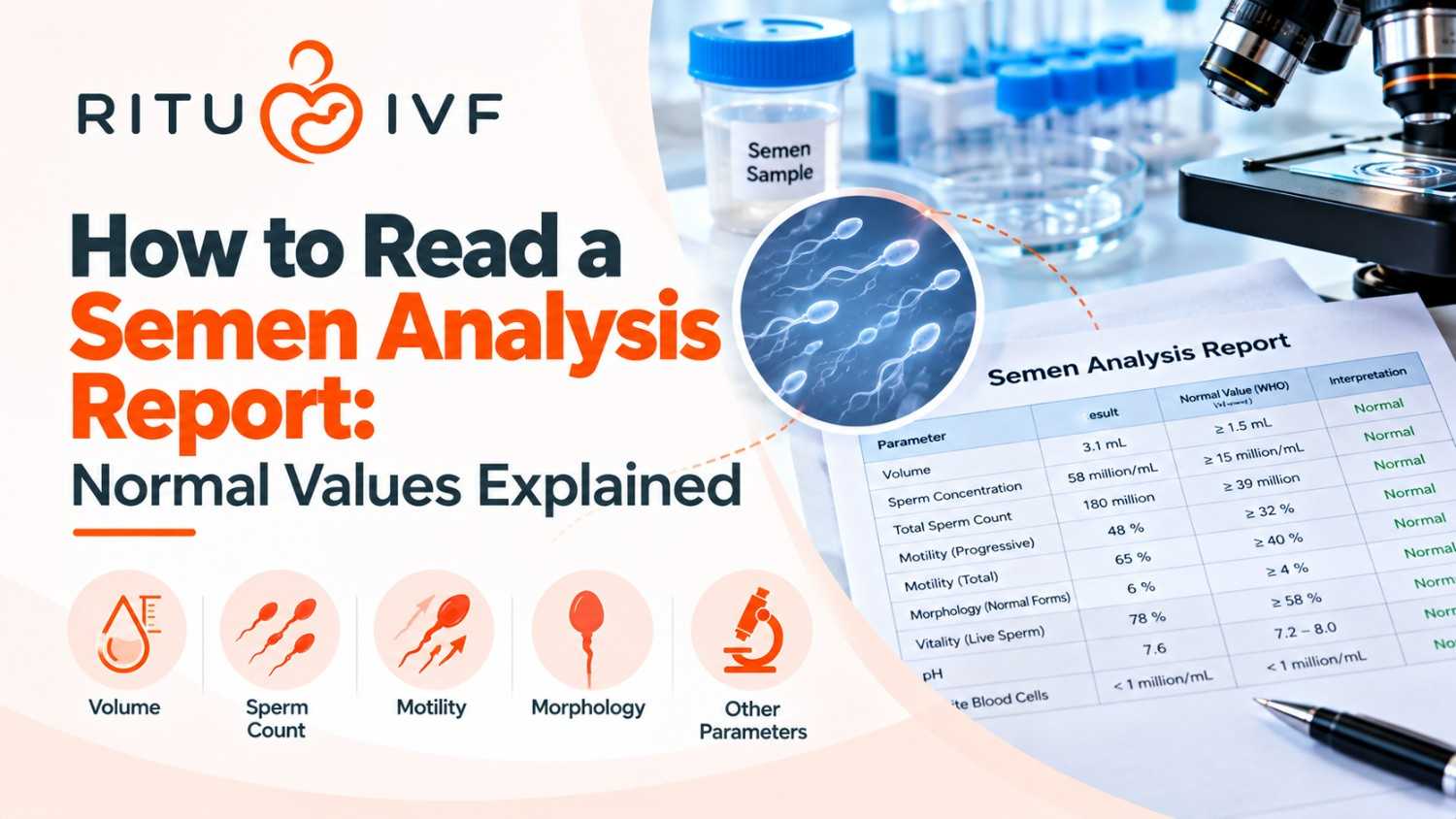
Quick Answer: A semen analysis report measures sperm count, movement (motility), shape (morphology), and semen volume. To read it, compare each value with the WHO 2021 reference limits printed on your report: at least 16 million sperm per millilitre, 42% total motility, 30% progressive motility, 4% normal shapes, and 1.4 ml volume. One low value does not confirm infertility, so the full picture matters.
Need an Appointment?
CLICK HEREGetting a semen analysis report in your hands can feel confusing. It is full of numbers, percentages, and technical words, and it is natural to worry when you do not know what any of it means.
The good news is that the report is simpler than it looks once you understand the main parameters. In this guide I will explain how to read a semen analysis report, what the normal values are according to the latest WHO 2021 standards, and what the results actually tell you about fertility.
What Is a Semen Analysis?
A semen analysis is a basic laboratory test that checks the health of a man’s sperm and semen. It is one of the first and most useful tests in any fertility evaluation, because male factors contribute to a large share of fertility difficulties.
The test looks at a single ejaculated sample and measures several things, including how many sperm there are, how well they move, and what shape they are. Each of these values is then compared against standard reference limits set by the World Health Organization.
The WHO 2021 Normal Values (Reference Limits)
The most important thing to know is that the reference values were updated in 2021, in the WHO’s sixth edition manual. If your report uses older values, the numbers may differ, so always check which standard your lab has used.
Here are the current WHO 2021 lower reference limits, which your results should ideally meet or exceed:
| Parameter | What it measures | WHO 2021 lower limit |
|---|---|---|
| Semen volume | Total amount of semen | 1.4 ml or more |
| Sperm concentration | Sperm per millilitre | 16 million/ml or more |
| Total sperm count | Total sperm in the sample | 39 million or more |
| Total motility | Sperm that are moving | 42% or more |
| Progressive motility | Sperm moving forward | 30% or more |
| Vitality | Live sperm | 54% or more |
| Morphology | Normal-shaped sperm | 4% or more |
These limits represent the lowest 5% of recently fertile men. In simple terms, they are a reference point, not a strict pass-or-fail line.

Ready to take the next step toward parenthood
How to Read Your Report, Step by Step
Reading the report becomes easy when you go through it in order rather than jumping to one scary number. Here is a simple approach.
First, check the physical details, called the macroscopic section. This includes semen volume, colour, pH, and liquefaction, which is how the sample turns liquid after collection.
Next, move to the microscopic section, which covers the sperm themselves: concentration, total count, motility, and morphology. Finally, read any comments or conclusions the lab has added at the end.
Understanding Each Parameter
Let us break down the key values so each one makes sense.
Semen volume is the total amount of fluid. A low volume can sometimes point to a blockage or a collection issue, while the fluid itself mostly comes from the prostate and seminal vesicles.
Sperm concentration and total count tell you how many sperm are present. Concentration is the number per millilitre, while total count is concentration multiplied by volume. It is worth knowing that a man can have a slightly low concentration but still a healthy total count if his volume is good.
Motility describes movement. Total motility counts all moving sperm, while progressive motility counts those swimming forward in a useful direction, which matters most for reaching the egg.
Morphology describes the shape of the sperm under a microscope, using strict criteria. A value may look alarmingly low, but under these strict standards, 4% normal forms is considered within the reference range.
What the Common Abnormal Terms Mean
Your report may use medical terms if a value falls below the reference limit. Knowing them removes a lot of the fear.
- Oligospermia means a low sperm count
- Asthenozoospermia means reduced sperm movement
- Teratozoospermia means a higher number of abnormally shaped sperm
- Azoospermia means no sperm found in the sample
- Oligoasthenoteratozoospermia (OAT) means count, motility, and shape are all below range
These terms describe findings, not final verdicts. Many men with one of these findings still father children, sometimes naturally and sometimes with help.
One Low Value Is Not the Whole Story
This is the most important message, and it is one that many reports do not explain clearly. A single below-range value does not mean you cannot have children.
Sperm quality naturally varies from sample to sample, depending on factors like recent illness, fever, stress, or the gap since the last ejaculation. This is exactly why doctors often repeat the test after a few weeks before drawing any conclusion.
Morphology in particular is a weak predictor on its own, and conception has been documented even at lower values when other parameters are adequate. So the pattern across all values, and across repeat tests, matters far more than any one number.
Need an Appointment?
CLICK HEREWhat to Do If Your Results Are Below Normal
If one or more values are below the reference limit, the sensible next step is not panic, but a proper review with a specialist. A single report is only a snapshot.
Your doctor may suggest repeating the test, checking for underlying causes, or simple lifestyle improvements that support sperm health over time. If a genuine issue is found, there are effective treatments, and techniques like ICSI can help even when sperm quality is low. You can also read more about the causes and treatment of low sperm count.
A Note From the Clinic
A semen analysis is a helpful tool, but it is only one part of a couple’s fertility picture. It should always be read alongside the female partner’s assessment and your overall history, rather than in isolation.
Outcomes vary from person to person, and your own situation depends on many factors beyond a single test. The best way to understand your report is to discuss it with a qualified specialist who can see the full context.
Summary
A semen analysis report measures sperm count, motility, morphology, volume, and vitality, and each value is compared against the WHO 2021 reference limits. Reading it in order, from the physical details to the sperm parameters, makes it far less intimidating.
Most importantly, remember that one low value is rarely the whole story. A proper diagnosis comes from the complete picture and, often, a repeat test.
Have Questions About Your Report?
If your semen analysis results have left you worried or confused, an honest discussion with a specialist can give you real clarity on what they mean for you.
To understand your report and your options, book a consultation with Dr. Ritu Agarwal through our contact page, or call +91 9057000555.
Frequently Asked Questions
What are normal semen analysis values?
Under WHO 2021 limits, normal values are at least 1.4 ml volume, 16 million/ml sperm concentration, 39 million total count, 42% total motility, 30% progressive motility, 54% vitality, and 4% normal morphology.
What is a normal sperm count?
A sperm concentration of 16 million per millilitre or more, and a total sperm count of 39 million or more per sample, are considered within the WHO 2021 reference range.
My morphology is low. Should I worry?
Not necessarily. Morphology uses strict criteria, and 4% normal forms is within range. It is a weak predictor on its own, so it should be read alongside your other values.
Does one bad report mean I am infertile?
No. Sperm quality varies between samples due to illness, stress, or the gap since last ejaculation. Doctors usually repeat the test before reaching any conclusion.
How is the sample collected for accuracy?
It is usually collected after 2 to 7 days of abstinence, as advised by the lab. Following the lab’s exact instructions helps give an accurate result.
What do terms like oligospermia or azoospermia mean?
Oligospermia means a low sperm count, and azoospermia means no sperm were found in the sample. These are findings that need a specialist’s review, not final verdicts.
Medical Disclaimer: This article is for general information and awareness only. It is not a substitute for personal medical advice. Please discuss your specific situation with a qualified fertility specialist. This article was prepared with the help of research and digital/AI tools and reviewed for accuracy by Dr. Ritu Agarwal.