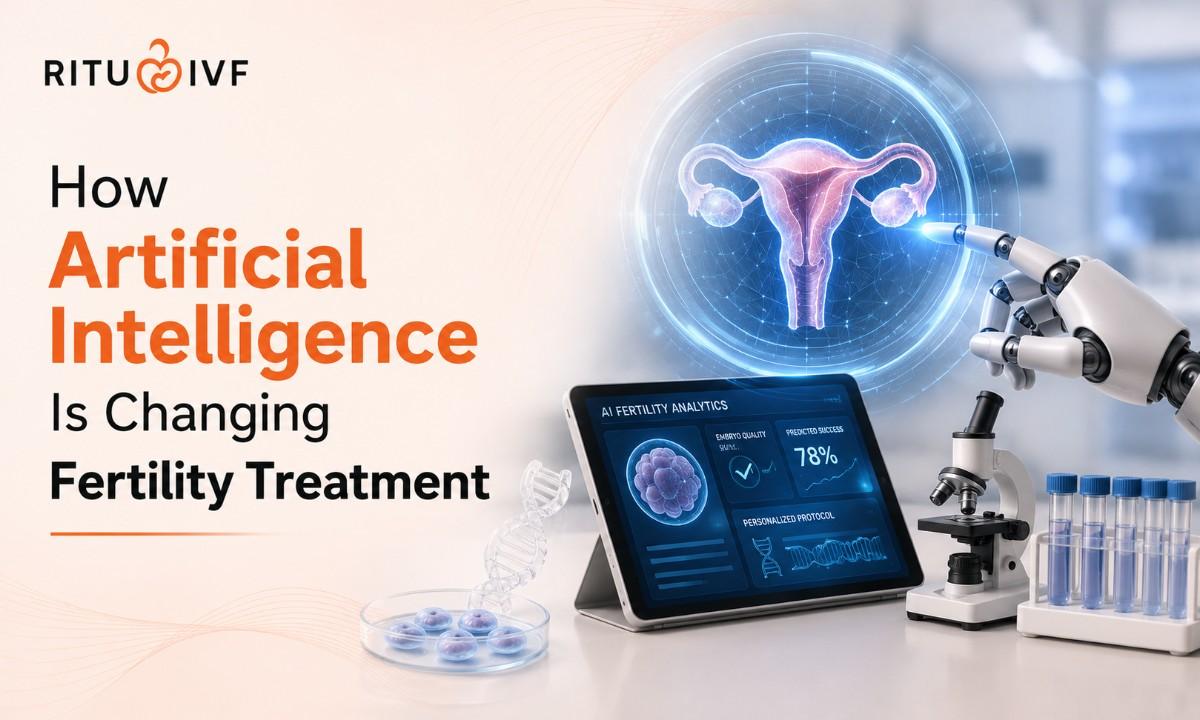
Quick answer: AI in IVF means using computer systems trained on large amounts of fertility data to support key decisions during treatment, such as monitoring follicles, grading embryos, and predicting which embryo has the best chance of a healthy pregnancy. It works alongside your fertility doctor and embryologist, adding speed and objectivity, but it does not replace their judgment.
If you have been on the IVF journey, you already know how much rides on small, precise decisions. Which follicle is ready. Which embryo to transfer. When to time the cycle. For decades these choices depended almost entirely on the trained eye of a specialist. That is still true today, but something important has changed. Artificial intelligence (AI) now works alongside fertility experts, helping them make these calls with more consistency and precision than before.
This is not science fiction. AI is already inside modern fertility clinics, including here in Jaipur. If you are considering IVF treatment or are already in a cycle, understanding AI in IVF can help you ask sharper questions and feel more in control of your care.

Ready to take the next step toward parenthood
What Does “AI in IVF” Actually Mean?
At its simplest, AI in IVF means using computer systems trained on huge amounts of fertility data to spot patterns the human eye may miss. These systems learn from tens of thousands of past cases, including which embryos went on to become healthy pregnancies.
The most common form used today is deep learning, a type of AI that reads images and video. In a fertility clinic, this usually means analysing ultrasound scans during monitoring, or studying time-lapse images of embryos as they grow, then scoring each one.
The key point to hold onto: AI in fertility is a support tool for your doctor and embryologist, not a machine that runs treatment on its own. It adds a second, data-driven opinion to the expert judgment your team already brings.
How AI Helps at Each Stage of an IVF Cycle
AI is not limited to one step. It now supports the whole treatment journey:
- Ovarian stimulation planning: AI can study your hormone levels, age, and history to help fine-tune medication doses, supporting a personalised stimulation protocol instead of a one-size-fits-all plan.
- Follicle and endometrial monitoring: AI-enabled ultrasound can measure follicle growth and assess the uterine lining more accurately and consistently than manual scanning.
- Egg and sperm assessment: AI can analyse the shape (morphology) and movement (motility) of eggs and sperm in fine detail.
- Embryo monitoring and selection: Inside a time-lapse incubator, embryos are imaged continuously without being disturbed, and AI ranks them by likelihood of implantation.
- Outcome prediction: Predictive models help your doctor give you a clearer, more honest picture of your chances.
For a refresher on how a standard cycle works, see our detailed guide on the steps involved in the IVF process.
Need an Appointment?
CLICK HEREAI in Embryo Selection: The Biggest Breakthrough
Choosing the right embryo to transfer is one of the most decisive moments in IVF. Traditionally, embryologists grade embryos by eye under a microscope. The problem is that this is subjective. Two skilled experts can grade the same embryo differently, and even the same person may score it differently on another day.
This is exactly the gap AI is filling.
How AI embryo scoring works
Modern labs use time-lapse incubators that record an embryo’s full development as a kind of video. AI studies this footage and assigns each embryo an objective score based on its predicted chance of implanting, without ever touching or disturbing it. That makes it a completely non-invasive technique.
Well-known AI tools in use today
- iDAScore: One of the most studied tools, trained on more than 180,000 embryo time-lapse sequences. A randomised controlled trial published in Nature Medicine via Vitrolife found it can be about ten times faster than manual grading with similar clinical outcomes.
- CHLOE: An AI platform that images embryos every ten minutes and analyses their full development to help identify the embryo with the highest chance of success.
- ERICA and MAIA: Deep-learning tools that add another layer of objective analysis for the embryology team.
The core value here is consistency. AI does not get tired or rushed. It applies the same standard to every embryo, every time.
AI Grading vs Manual Grading: A Quick Comparison
| Factor | Manual grading | AI-assisted grading |
|---|---|---|
| Objectivity | Depends on the individual | Same standard every time |
| Speed | Slower, hands-on | Ranking in seconds |
| Consistency | Can vary day to day | Highly consistent |
| Invasiveness | Non-invasive | Non-invasive |
| Final decision | Embryologist | Embryologist (AI advises) |
The takeaway: AI does not take over the decision. It gives your embryologist a reliable second opinion.
The World’s First Baby Born Through Fully Automated IVF
One of the most talked-about moments in fertility medicine happened on April 10, 2025, when the first baby was born following conception with a fully automated, remotely operated ICSI system, as reported by EurekAlert and the journal Reproductive Biomedicine Online.
Here is why it matters. ICSI (Intracytoplasmic Sperm Injection) is a technique where a single sperm is injected directly into an egg. Since the 1990s this has been done by hand. The new system automated all 23 steps of the procedure, with AI or a remote operator carrying out each step. The AI selected the sperm, immobilised it with a laser, and completed the injection with remarkable precision. Out of five eggs treated, four fertilised, and a healthy baby boy was born.
Being realistic: this was a single pilot case, and the automated process currently takes longer than the manual one. It is not yet a routine treatment. But it points clearly to where the field is heading.
Need an Appointment?
CLICK HEREHow AI Supports Male Fertility Treatment
Male factor infertility contributes to a large share of cases, so this matters.
- Smarter sperm analysis: AI can assess sperm count, shape, and movement more consistently than a manual semen analysis.
- Better sperm selection: In advanced systems, AI can help identify the healthiest sperm for injection during ICSI, which is especially useful when sperm quality is low.
Does AI Improve IVF Success Rates?
Here is the honest answer. The strongest evidence shows AI embryo selection is at least as reliable as expert manual grading, and considerably faster and more consistent. Some studies report improved implantation rates when AI supports selection, though results vary between clinics.
What AI does most reliably is:
- Remove subjective bias from grading and monitoring.
- Save time so specialists focus on complex tasks.
- Support single embryo transfer, lowering the risk of a multiple pregnancy while keeping success chances strong.
AI does not guarantee a baby, and no honest clinic will claim that. It strengthens the decisions behind your cycle. For the lifestyle and medical factors that genuinely move the needle, read our guide on how to improve your chances of IVF success.
Ready to take the next step toward parenthood
AI at Ritu IVF: Rajasthan’s First AI-Enabled Ultrasound
We do not just talk about AI, we use it. In early 2026, Ritu IVF became the first IVF centre in Rajasthan to install an AI-enabled ultrasound (USG) machine, as reported by Business Remedies.
This technology uses AI-based advanced imaging to make three things far more precise:
- Follicle monitoring: accurate, timely assessment of ovarian activity, which supports better cycle decisions.
- Endometrial assessment: clearer evaluation of the uterine lining before transfer.
- Cycle timing: more exact timing of the key steps in your IVF cycle.
As Dr. Ritu Agarwal has put it, modern IVF should rest not only on experience, but on precise technology, data-driven decisions, and transparency. Automated measurement and standardised reporting reduce human error and make each decision more scientific and reliable.
If you are just starting out, you may also find it helpful to read how to prepare for IVF and how a frozen embryo transfer works.
The Honest Limits: What AI Cannot Do
Good medicine means being transparent about limits, not just benefits.
- It does not replace your doctor or embryologist. AI provides a score. The final medical decision always rests with a trained expert who knows your full history.
- It is only as good as its data. A model trained on one population may perform differently elsewhere, so ongoing validation matters. Recent 2026 research is still studying how stable AI embryo-ranking models are.
- It cannot change biology. Age, egg quality, and underlying health still shape your outcome. AI helps you make the best of your situation, not rewrite it.
At a good clinic, AI is one more layer of care within an experienced team, not a shortcut around one.
Frequently Asked Questions
What is AI in IVF?
AI in IVF means using computer systems trained on large fertility datasets to support decisions during treatment, most commonly to monitor follicles on ultrasound and to analyse and rank embryos by their chance of a successful pregnancy. It works alongside your doctor as a support tool.
Does AI increase IVF success rates?
AI matches or improves the consistency of embryo selection compared with manual grading and is much faster. Some studies report better implantation rates. It improves decision quality but cannot guarantee pregnancy, since age and egg quality still play a major role.
Is AI-based embryo selection safe?
Yes. The common AI tools analyse images from time-lapse incubators without touching the embryo, so the process is completely non-invasive and adds no risk.
Can AI replace embryologists or doctors?
No. AI provides an objective score or ranking, but the final decision always rests with your embryologist and fertility doctor, who consider your complete medical picture.
Was a baby really born using AI IVF?
Yes. In April 2025 the first baby was born following conception through a fully automated, remotely operated ICSI system. It was a pilot case and is not yet routine, but it marked a major step toward lab automation.
Does Ritu IVF use AI technology?
Yes. Ritu IVF became the first IVF centre in Rajasthan to install an AI-enabled ultrasound machine, used for more accurate follicle monitoring, endometrial assessment, and cycle timing.